The rules, paraphrased
How the técnico-mecánica works
What the official inspection of a motorcycle is, when it is due, what the centre looks at and how a motorcycle passes. The official texts are named under each part.
What the técnico-mecánica is
The revisión técnico-mecánica y de emisiones contaminantes (RTM) is the official inspection of a vehicle’s condition and exhaust gases.
Only a Centro de Diagnóstico Automotor (CDA) registered in RUNT can do it. The certificate is issued electronically and anyone can look it up in RUNT.
DASA MOTOS is a motorcycle workshop, not a CDA. This app helps you prepare; it does not inspect or certify anything.
Source: Ley 769 de 2002, art. 53 (as amended by Decreto 019 de 2012 and Decreto 2106 de 2019) – www.funcionpublica.gov.co
When your motorcycle needs it
A new motorcycle has its first inspection when it turns two years old, counted from the date of its matrícula (registration).
After the first one, the inspection is every year.
The app works out an expected date from the dates you enter. The date shown in RUNT is the one that counts: enter it in the motorcycle form and the app uses it.
Source: Ley 769 de 2002, art. 52 as replaced by Ley 2294 de 2023, art. 179; art. 51 as replaced by Decreto Ley 019 de 2012, art. 201 – www.funcionpublica.gov.co
What to bring
The licencia de tránsito of the motorcycle, and a SOAT that is valid on the day. The centre checks both in RUNT.
Your driving licence: the centre may ask for it to check its restrictions.
The motorcycle clean enough to inspect and without loads. The centre compares its plate, make, class, service and colour with the licencia de tránsito.
Source: Ley 769 de 2002, art. 53; Resolución MinTransporte 20223040045295 de 2022, arts. 3.3.4.1 and 3.3.4.5; NTC 5375:2012, 5.1 and 5.2 – cancilleria.gov.co
How a motorcycle passes
Every fault found is a type A defect (serious, an immediate danger to safety or the environment) or a type B defect (a possible danger).
A motorcycle fails with one type A defect, or with five or more type B defects. It passes with no type A defect and fewer than five type B defects.
Each item in the self-check shows its type: "Type A: one fails the test", "Type B: five fail the test", or "Needed before the test" for papers.
Source: NTC 5375:2012, section 4 and chapter 7 – www.aso-cda.org
What is checked
Eleven parts of the standard, nine groups here
For motorcycles the standard lists: the outside and the frame, the mirrors, the seat and footrests, noise devices and the horn, lights and signals (with a light meter), exhaust gases, brakes (with a brake tester), suspension, steering, rims and tyres, the parking stand, and the engine and gearbox.
The drive chain and the tyre pressure are not items of the motorcycle chapter, but a worn chain or soft tyres still deserve a look before a ride to the centre.
- Papers and identification (6 items)
- Lights and signals (7 items)
- Brakes (10 items)
- Wheels and tyres (7 items)
- Suspension and steering (5 items)
- Body, frame and mirrors (7 items)
- Seat, footrests and stand (3 items)
- Exhaust, noise and horn (4 items)
- Engine and wiring (4 items)
The headlight test
The headlight must give at least 2.5 klux at 1 m (or 4 lux at 25 m), measured with the engine revved for the brightest light.
On low beam the light must point down by 0.5 to 3.5 %. At home: 5 m from a wall, the centre of the low beam should fall 2.5 to 17.5 cm below the headlight’s height.
Turn signals, brake lights and light switches that do not work, missing lenses or wrong colours are type A defects; dashboard lights are type B.
Source: NTC 5375:2012, 7.4 – www.aso-cda.org
The brake test
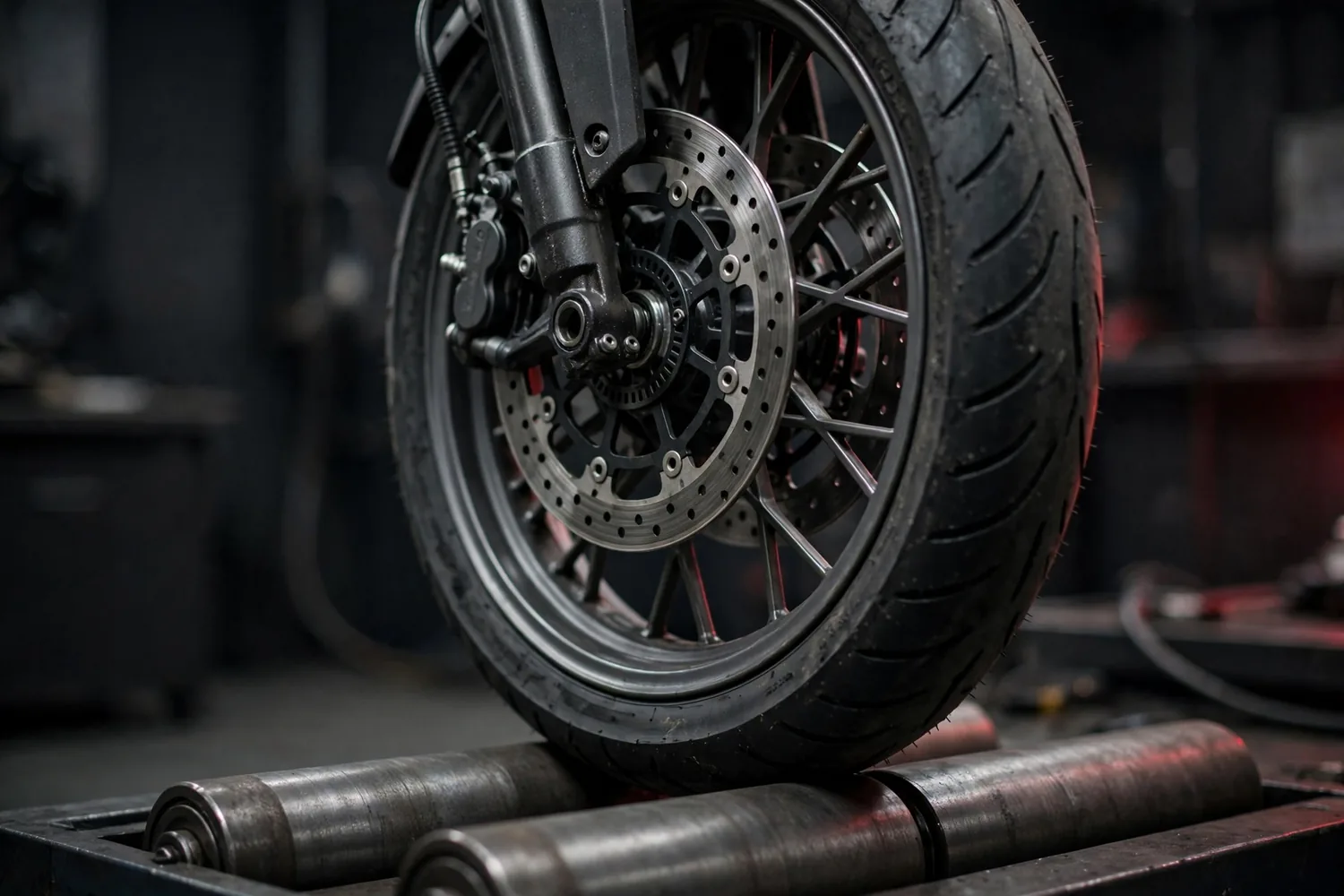
On the rollers the motorcycle must reach at least 30 % braking efficiency (braking force compared with its weight). A wheel with no brake at all fails.
Leaks at the pump, hoses or caliper, a missing reservoir cap and worn cables are type A defects; a fluid level outside the marks is type B.
Source: NTC 5375:2012, 7.6 – www.aso-cda.org
Tyres and rims
In its most worn part each tyre needs at least 1 mm of tread and must not be below the maker’s wear marks.
Cuts, bulges, splits, bent or cracked rims and missing wheel nuts are type A defects.
Source: NTC 5375:2012, 7.9 – www.aso-cda.org
What the inspection costs
Each CDA sets its price within the range regulated for motorcycles. Prices published for 2026 are about $ 218.000 to $ 248.000. Ask your centre for its exact price.
Source: Prices published by CDAs and RTM guides in 2026 (for example CDA Servisuper, Grupo R5) – www.grupor5.com
Which standard applies
The items and types in this app follow NTC 5375:2012, the edition inspection centres are accredited on for motorcycles as of September 2026. ICONTEC published a new edition in 2024; if the Ministerio adopts it for motorcycles, the app will be updated.
Source: ONAC technical note NTE-3.3-77 (October 2024) and ONAC accreditation records (September 2026) – onac.org.co
About this app
This app is a pre-check made for DASA MOTOS. It has no link to RUNT, the Ministerio de Transporte, the Superintendencia de Transporte, SIMIT or any inspection centre.
The rules are paraphrased; the official texts named under each part are what counts. A home check cannot replace the centre’s instruments.
Check it before you pay the CDA
Go through what the inspection looks at, group by group, mark what is wrong and send the fixes you want to DASA MOTOS on WhatsApp or by email.